


CODE OF CONDUCT
You can swipe back and forth here.
1.1. Dance happily!
motion*s is a place where people can grow through dance and feel comfortable. Here, we train, exchange, inspire and motivate one another. Here, dance is understood as more than just movement. It is a living culture that connects people and should be preserved.
Dance is understood not merely as movement, but as a living culture that connects people and is worth preserving. Through a wide range of offerings such as dance classes, dance parties, or sessions, we create opportunities for encounters, for getting to know new styles, and for deepening techniques.
1.2. Cultural sensitivity.
motion*s values respect and appreciation for all cultures. Dance styles are often deeply rooted in specific cultural contexts and connected to historical and social meanings. For this reason, we carefully select teachers based on their skills, knowledge, and active involvement in the respective dance scene. It is not necessary for teachers to be from the culture of origin of a specific dance style. What matters is conveying the origins and traditions with care, authenticity, and respect—the historical context should be an integral part of the teaching. Whenever possible, motion*s integrates conversations about styles and culture into workshops and special classes and opens up space for self-organized events on these topics.
1.3. A space for many and for diversity.
At motion*s, people with different interests, backgrounds, and lived realities come together every day – and not only in relation to dance. It is a place where different genders, identities, origins, age groups, people with varying abilities, and diverse socio-economic backgrounds come together. In this diversity, multiple truths can exist at the same time – and each of them is valid.
1.4. Opportunities for free expression in safe spaces.
It is important to us to respond to different needs as best as we can. With our spatial conditions and our offerings, we aim to find the best possible solutions.
1.5. International and local.
The multilingual dance community communicates primarily in English, but we also offer classes in German to remain locally accessible. With classes in both German and English, we aim to ensure that both non-German speakers and German-only speakers can participate in our program.
1.6. Low-barrier access.
We place great importance on creating offerings for people with varying needs and backgrounds. Through collaborations with foundations and programs of the State of Berlin, we want to make it possible for individuals with limited financial means to participate in our classes. Our pricing reflects the financial realities of operating a dance and movement studio. At the same time, we are constantly looking for ways to make dance accessible to as many people as possible—for example through affordable sessions or donation-based events. In addition, we offer classes for different age groups and all levels—from beginners to advanced dancers—as well as open formats, so that everyone can find a class that suits them. From a first dance experience to many years of continuous practice.
At motion*s, we welcome all people regardless of their background or abilities. We are open to new encounters and value honest, authentic, and respectful interaction.
We stand for tolerance and do not accept racism, sexism, ableism, queer- and transphobia, body shaming, or age discrimination. For us, respectful interaction is the foundation of every exchange – both on and off the dance floor.
-
- Respect for the diversity of identities
We respect and value individual differences. At motion*s, dance shapes movement from within and should not be forced into predefined positions, especially if they contradict individual physical possibilities. - Respectful communication
We value conscious and considerate use of language and do not tolerate racist, sexist, or ableist remarks, nor assumptions about others’ origins, abilities, or appearance. - Mindfulness in behavior
Body language aligns with the values of mutual respect. This includes, for example, refraining from unsolicited physical contact or inappropriate approaches. - Active intervention in cases of discrimination
We do not tolerate any form of discrimination or harassment. If discriminatory behavior occurs, we expect everyone—whether front desk staff, office team, teachers, or participants—to actively intervene. - Education and reflection
An essential part of engagement against discrimination is the ongoing reflection on one’s own privileges and biases. motion*s encourages open engagement with personal patterns of thinking and a mindset of learning and growth.
- Respect for the diversity of identities
- 2 locations
- approx. 200 classes per week
- approx. 45 styles
- 5 different levels
- 10-, 6-, and 4-month training programs
- Workshops
- Intensive weeks
- Parties and motion*s club nights
- Collaborations with public schools
- Workshops for groups and events
- Private lessons
- Studio rentals
This wide range of offerings is shaped by around 13 office staff members, approximately 50 front desk staff, and about 140 teachers — supported by substitute teachers as well as our cleaning and maintenance team.
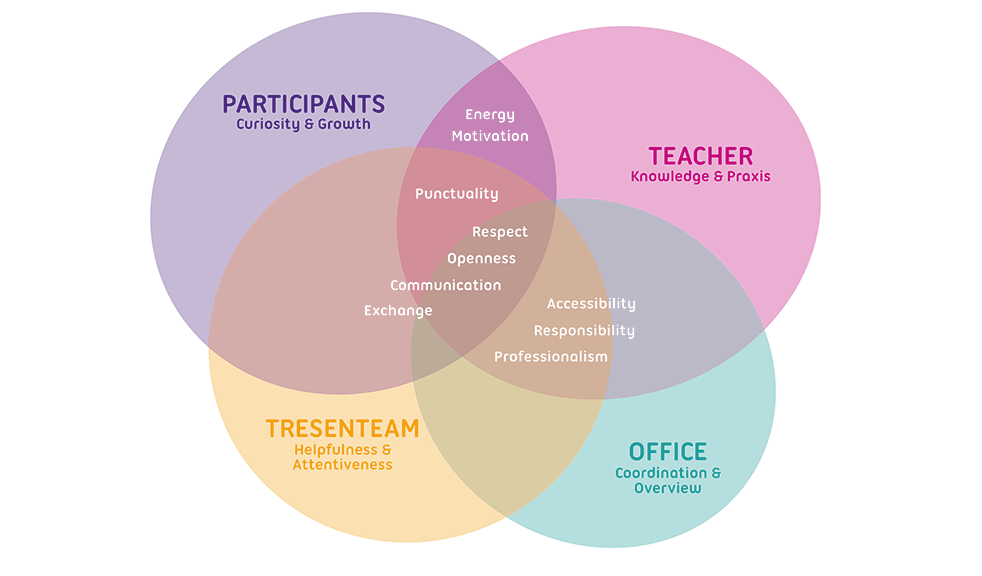
All roles at motion*s, along with the responsibilities and functions associated with them, are interconnected and exist in reciprocal relationship with one another. Some people take on several roles at the same time:
4.1. Participants
All participants take part in classes actively and with responsibility. They are responsible for their own development and ensure they understand the instructions of the teachers by asking questions whenever something is unclear. Participants help shape the atmosphere in the classroom through their commitment and energy. Their behavior influences the group dynamics and overall energy level of the class. They arrive on time, stay attentive, and treat teachers and other participants respectfully.
Participants ideally attend the entire class to fully support the collective learning process and provide themselves with the best learning experience. As a private dance school, motion*s points out that each participant is responsible for their own health and safety during the class. If participants are limited due to health or personal reasons, such as low energy or injury, or need to leave the class early, they will proactively communicate this to the teachers in advance.
Participants show openness toward the teachers and their expertise. They engage openly with the class or inform themselves in advance about the course content, dance style, and teacher in order to participate with realistic expectations. Questions, concerns, or special needs are addressed either directly to the teachers or at the front desk.
The use of mobile phones during class is limited to what is absolutely necessary and must be agreed upon with the teachers in advance. Video recordings are made only with prior consent from the teachers and the other participants. During class, participants share responsibility for ensuring that windows are properly closed while music is playing.
Participants respect the time capacity, workplace, and role of the front desk staff and act considerately. Larger concerns are communicated via email. Before each class, participants register their attendance properly and on time at the front desk. Late arrival is communicated by phone. Five minutes after the start of the class, the spot is released to the waiting list.
Participants pay class fees reliably and on time to ensure the continuation of high-quality classes. Participants are responsible for their valuables and for cleaning up after themselves. This includes in particular returning used materials, dishes, and disposing of waste. motion*s is and remains a second home and is treated with care and appreciation.
4.2. teachers
Teachers at motion*s do not only teach dance techniques; through their work, they also fulfill a cultural mission. Dance is an expression of history, community, and identity—and every single class or workshop contributes to the living transmission of this dance culture. The moment of teaching is the moment in which knowledge, experience, and inspiration are passed on, and where the real magic happens. The work of the teachers thus forms the heart of our studio, and we deeply value their commitment, expertise, and passion for sharing dance.
Teachers are carefully selected based on their skills, knowledge, and engagement within their respective scenes. They do not necessarily have to come from the culture of origin of a dance style; however, they carry the responsibility to represent its origins, traditions, and historical contexts with care, authenticity, and respect. In addition to teaching techniques and vocabulary, they convey the cultural context of each style, act as a source of inspiration and motivation for participants, and bring both solid knowledge and respect for the cultural roots of the dances they teach. Formal historical lectures are not required; teachers communicate transparently the extent and timing in which they address these backgrounds. In any case, they are knowledgeable about the cultural origins, acknowledge them respectfully, and are open to conversations about them. Upon request, they provide references or further resources (e.g., literature, links, or recommendations), enabling participants to explore the history independently.
Teaching dance also entails responsibility for the physical and personal development of participants. Teachers create a motivating and respectful learning environment and bring energy and attentiveness to every class. They use mindful language and address participants with care. Instruction follows the principle of healthy training “from the inside out.” Movements should be learned and performed with an understanding of one’s own body, its capabilities, and its limits. Exercises are to be understood as opportunities for development, not as obligations or coercion. Teachers motivate and challenge without overburdening participants, and they respect individual physical differences and boundaries. When working with minors in particular, teachers assume a pedagogical responsibility.
Teachers are punctual and take responsibility for the careful planning and delivery of their classes. During course time, they are the primary point of contact for class-related matters. They are familiar with the equipment used and ensure that materials are returned to their proper place after class. Windows remain closed while music is playing.
In cases of substitutions, cancellations, or special incidents, teachers proactively inform the office, front desk, or colleagues and ensure a proper handover. In their interactions, teachers treat one another with appreciation, respect different working styles, and, when necessary, find constructive compromises—for example regarding volume or room usage. They ensure that classes end on time and that rooms are left clean. Collaboration with front desk staff is characterized by clear and respectful communication. Teachers check in at the front desk before class and announce guests or special concerns in a timely manner. The correct and punctual preparation of invoices is also part of their responsibility.
4.3. front desk staff
The front desk staff serve a service function and often shape the first impression of motion*s. They should therefore be welcoming, open and respectful. Front desk staff act as representatives of the studio.
They should be thoroughly informed about classes, workshops and events, rooms, procedures and memberships. They are expected to inform and advise participants about offerings.
Front desk staff manage the waiting list and decide on late entry. It is important to act in coordination with the teachers. Spots that are not taken can be offered to those on the waiting list no earlier than five minutes after the start of class.
Key responsibilities at the front desk include counting participants in classes, pointing out missing registrations, and ensuring the correct processing of teachers’ fees.
Front desk staff are expected to support teachers in handling challenges with participants, remind them to close windows, and monitor class volume.They are responsible for the atmosphere in the foyer and general traffic areas. When necessary, front desk staff may intervene in cases of noise disturbances or disruptive behavior in the foyer. They always work as a team, perform their tasks reliably, and ensure the punctual handover of front desk shifts.
4.4. office team
The office team takes on the administrative, organizational, and coordination functions under the leadership of management. It provides the framework in which teachers and participants can share, discover, and develop their passion for dance.
The main responsibilities of the office team include the long-term planning and implementation of a diverse range of classes, events, intensive courses, workshops, and programs, as well as their promotion, scheduling, and the timely organization and provision of the necessary spaces and materials.
The office communicates clearly, honestly, and respectfully within the team as well as with teachers, front desk staff, and participants. The team takes responsibility for matters and questions that the front desk staff cannot address.
To create an atmosphere in which all involved feel comfortable, the office team ensures the continuous evaluation, further development, and quality assurance of offerings and processes.
It is important to the office team that teachers, as independent professionals, are paid fairly, properly, and on time. The office requests that all contact be made exclusively via email or telephone.
4.5. cleaning and maintenance team
The cleaning and maintenance team ensures cleanliness, order, and the upkeep of the facilities without disrupting the operations of the studio. They make sure that all equipment and installations function properly. For a harmonious and supportive work environment, respectful collaboration among themselves and with everyone else is essential. The cleaning and maintenance team contributes to making the dance studio a place where everyone feels welcome and comfortable. All parties are expected to respect the work of the cleaning and maintenance team, use the spaces and resources responsibly, and report any repairs immediately – to the front desk staff for participants and teachers, and to the office team for the front desk staff.
4.6. guests
Guests – including guardians, tenants of the facilities, participants in school collaborations, and party attendees – are also expected to behave respectfully and mindfully. Guardians are responsible for their children, particularly regarding noise levels and tidiness, ensuring that rooms are left in an orderly state after use.
4.7. awareness team
The motion*s Awareness Team is a neutral point of contact, providing support to anyone experiencing discrimination or inappropriate behavior. Affected individuals can reach out with their concerns at awareness (at) motionsberlin.de.
In the event of conflicts, the team can offer mediation and assist with resolution. However, it is not the responsibility of the Awareness Team to implement measures or make decisions – this responsibility lies with the motion*s management. Likewise, the team is not responsible for providing information or advice on external training opportunities.
Currently, the team consists of office staff, supported by teachers and management.
The whole motion*s community takes responsibility – both for ourselves and for the situations around us. The goal is not to be flawless, but to acknowledge our mistakes and adjust our behavior in interactions with others.
If a member of the motion*s community refuses to communicate, fails to offer appropriate apologies, or does not take responsibility for their behavior, we are compelled to act consistently. In such cases, a ban from the premises will be issued as a last step.
6.1. What is a Code of Conduct?
A Code of Conduct is a set of behavioral guidelines that creates accountability through clear rules and provides a foundation for respectful interaction. It helps distribute responsibility and serves as a tool for addressing immediate problems and conflicts.
6.2. A Code of Conduct can…
…communicate values and inspire respectful interaction.
…provide transparency, guidance, and structure.
…define roles and therefore clarify responsibilities.
…assist in handling conflicts.
…encourage reflection on one’s own behavior.
…offer points of contact.
6.3. A Code of Conduct cannot…
…serve as a shield.
…take away personal responsibility.
…prevent conflicts.
…solve societal or political problems.
6.4. Why do we have a Code of Conduct?
motion*s is a place for dance and movement. Since its opening in 2012, it has been very important to founder Stella Caric that people can develop, grow, and feel comfortable in a welcoming and community-oriented studio atmosphere.
The diversity of people, all the encounters, and the growth of motion*s with the opening of a second location (2023) prompted the motion*s team to create a shared agreement for positive interaction – a commitment that everyone involved can agree to, engage with and refer to. We decided to put into writing the foundational principles on which being together at motion*s is built. This allows us to define what coming together at motion*s means for us. We are many: class participants, children with guardians, teachers, office and front desk staff, cleaners and maintenance staff – all coming together daily at both motion*s locations. Together, we shape the atmosphere in the studios, the interactions before and after dance, and our relationship with the surrounding neighborhood.
This Code of Conduct also includes certain rules that currently reflect aspects of house rules. Since there is no separate house policy at present, these points are integrated here. In the future, these contents may be moved into a separate house policy.
6.5. The history of our Code of Conduct
The development of the motion*s Code of Conduct was initiated and overseen in 2023 by the office team together with management. The goal was to reflect the diverse realities at motion*s and to stay as close as possible to the different roles, perspectives, and lived experiences of the community. In a multi-stage, time-intensive process – sponsored and supported by motion*s – various groups were repeatedly invited over an extended period to contribute their perspectives. In workshops, moderated working sessions, and discussion rounds, the viewpoints of teachers, front desk and office staff, participants, and other stakeholders were heard, discussed, and integrated into the development. The first draft was reviewed, revised, and refined multiple times until the Code of Conduct was published in February 2026.
6.6. Our Code of Conduct is meant to stay alive!
The Code of Conduct is intended to be updated annually and is understood as a living document that grows with the experiences, feedback, and needs of the community. Feedback on unclear points or suggestions for additions is expressly welcome. Please contact awareness (at) motionsberlin.de at any time!